

Article: Empègue: A Colorful Thread in Camargue History

Look for the word "empègue" in the folds of Occitan, and you'll discover its meaning in French: "to stick," with « empeguar » meaning « to stick ». The root of the word is pègue, which refers to resin or pitch used as glue. A simple meaning for a much more complex custom. Let's go back in time to the 20th century, when this tradition took root. Young men of 18, dressed in military uniform, were celebrated and honored by their loved ones. The walls of houses transformed into vibrant parchments, revealing paintings of pride and emotion.
THE MAGIC OF EMPÈGUES OF YESTERYEAR
Today, the tradition persists, but in a completely different form. The streets of Camargue villages buzz with youth and delight. During local festivals, intrepid teenagers roam the streets. They leave behind more than just a sweet treat. Armed with stencils and paint pots, they sketch empègues on facades, like ephemeral memorials of their passage. These drawings, these ancestral signs, tell stories much grander than themselves.


A JOURNEY INTO THE SYMBOLIC WORLD OF EMPÈGUES
Once made with whitewash and now with stencils, the motifs of the empègues draw from the imagination and strong symbols of the Camargue: the Camargue cross, the trident, but also the bull or the pink flamingo. They are often accompanied by the letters VLJ, for "Vive La Jeunesse" (Long Live Youth) or Viù Lo Joven in Occitan, as well as the year. Each empègue is unique and tells in its own way the story of a village, of a youth, and of a living heritage.
FROM HUMILITY TO LIVING HERITAGE
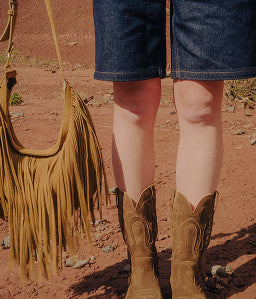
An empègue is not just a drawing on a wall. It is a direct link to the past and an ephemeral work of art that transcends eras. Much like the La Botte Gardiane boots that tread the Camargue soil, the empègue carries within it the memory of past generations and the promise of an enduring tradition.
So, the next time you walk through the cobbled streets of the Camargue villages around the workshop, such as Aigues-Vives, Junas, Calvisson, or further afield, stop and contemplate the empègues. They are silent witnesses to history, markers of life and of the love that this extraordinary land inspires in its inhabitants.
Artwork credits: Alice Haldenwang